> Science > Environment


A new study reveals an explosive, overlooked rise in lethal humid heat across South Asia, particularly Northeast India, with heat spells now lasting longer and occurring with minimal recovery time – creating an unprecedented "adaptability crisis."
While global attention often focuses on soaring dry temperatures, a critical threat is escalating silently across South Asia: extreme humid heat. A recent study, completed in October 2025 as part of doctoral research, shows a sharp rise in humid heat stress over the past two decades, fundamentally challenging human survivability and adaptation, especially in the traditionally overlooked Northeast Indian region (including Bangladesh) during the monsoon season.
The study, led by researchers from Cotton University, India, and international collaborators, uses the "Humidex" index to examine real heat stress levels, which combines temperature and humidity to describe how hot the air actually feels. The results show that extreme events with Humidex values above 45°C (severe conditions for survival) are now appearing more often and lasting longer, putting millions of people under severe stress. The findings are stark:
1. Quadrupled Exposure: In Northeast India, the annual number of critical heat stress days skyrocketed from roughly 20 days (1940s-1990s) to over 80 days in the 2020s. Total seasonal exposure hours surged from ~200±92 hours pre-1990s to 800±278 hours recently.
2. Longer, More Frequent Spells: The nature of exposure has catastrophically changed. The average duration of continuous extreme humid heat spells has more than doubled, rising from about 5 days in the past to nearly 10 days today. Meanwhile, the average recovery period between extreme heat spells has dropped dramatically, falling from more than 10 days to under 3 days.
3. Record-Breaking Durations: The longest annual extreme humid heat spell has tripled in length, jumping from ~10 days historically to over 30 days in the 2020s.
4. Rising Intensity: The intensity of the top heat stress events has also increased, with the average of the top three daily max Humidex values rising from ~47.3°C (1940s) to ~49°C (2020s).
"This isn't just more hot days; it's a fundamental shift in the character of heat stress," explains lead author Dr. Prolay Saha. "People are now facing marathon stretches of lethal heat with almost no time to recover in between. This is the core of the adaptability crisis."
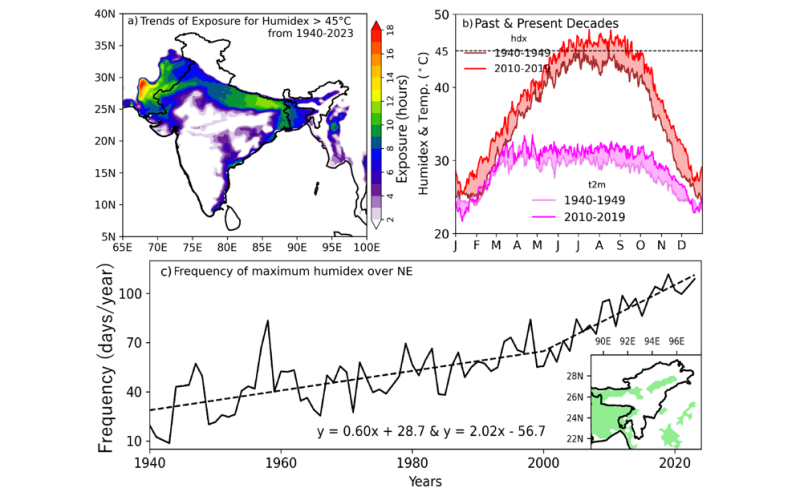
Figure : a) Long term (1940-2023) trends of hours of exposure of Humidex greater than 45 deg. C at each grid points over South Asia (Land), b) The difference (shaded red) between the mean annual cycle of maximum Humidex (hdx) for the past decade (1940-1949) and the present decade (2010-2019), along with the difference (shaded pink) in the annual cycle of daily maximum air temperature (t2m) at an urban location (Guwahati: 91.5E, 26N), and c) The time series shows the composite frequency (days/year) of maximum Humidex exceeding 45°C over plain locations (elevation < 200 m, as per DEM of SRTM data bilinearly interpolated to 0.25° × 0.25° horizontal resolution) in the Northeast region of the South Asian Monsoon domain during the MJJAS season from 1940 to 2023. The inset map highlights the study region of topographic height ? 200 m. The black dashed lines represent the best-linear fit trends for frequency for the periods 1940-1999 and 2000-2023. Source: THE RAINY SEASON AND INTRA-SEASONAL VARIABILITY (ISV) OF MONSOONAL RAINFALL OVER THE NORTHEAST INDIA AND ISV PREDICTION (Chapter 7), Cotton University, India.
The study identifies a decisive shift in the regional climate that began around the first decade (2000-2009) of this century. During this decade, the decadal-mean maximum Humidex crossed the critical 45°C threshold.
• Why is 45°C Decadal-Mean Critical? When the background climate mean Humidex is significantly above a critical threshold (like 45°C), even typical weather variations (like drier "break" spells in the monsoon) frequently push conditions into the extreme danger zone. Before 2000, the mean was slightly below 45°C, meaning only unusual conditions breached it. After crossing the threshold, the frequency exploded.
• Amplification Mechanisms: Global warming provides the base, but regional factors supercharge it. The Indian Ocean has warmed faster than most other oceans, loading the regional atmosphere with abundant moisture. Humidity exerts a nonlinear influence on heat stress. Even small increases in moisture at high temperatures cause a steep rise in Humidex values. The same moisture also affects the monsoon’s sub-seasonal patterns, extending and intensifying the dry phases known as break spells, which are closely linked with severe humid heat stress.
The convergence of longer heat spells and vanishingly short recovery gaps creates a physiological nightmare:
• Body's Limits Breached: Human thermoregulation relies on sweating to cool down. High humidity severely hampers sweat evaporation. Prolonged exposure (10+ day spells) overwhelms the body's ability to cope, leading to heat exhaustion, heat stroke, organ failure, and death. Short recovery gaps (3 days) are insufficient for physiological recovery, especially for vulnerable populations and outdoor workers.
• Beyond Northeast India: While Northeast India faces the most dramatic changes (being humid year-round), the crisis is widespread. The sub-Himalayan Gangetic plains, northwest India's semi-arid regions (like Jaipur), eastern India, Bangladesh, and parts of Pakistan all show similar alarming trend. The average duration of extreme humid heat spells has increased sharply, while the intervals between them have become much shorter. Jaipur, for instance, now experiences ~1500 hours of exposure annually, averaging a staggering 20 hours per day on critical heat days.
• Increased Variability: Adding to the risk, the year-to-year variability in spell length has also increased threefold, meaning unexpectedly long, deadly spells (15-20 days) are now more common.
The study sounds multiple alarms:
1. Flawed Heat Warnings: Current heatwave definitions and Heat Action Plans across South Asia rely almost exclusively on dry bulb temperature, ignoring humidity. A "heatwave" declared at 37°C dry temperature might feel like 53°C at 60% humidity – a critical difference not communicated. The authors demand heat stress indices like Humidex become standard in advisories.
2. Data Gap on Health Impacts: Systematic research on how these long spells of humid heat specifically impact morbidity (illness progression) and mortality is severely lacking, especially for outdoor workers. This data is crucial for designing effective interventions.
3. Rethinking Tropical Adaptation: The assumption that populations acclimatized to warm tropics are more resilient to climate change is challenged. The qualitative shift in heat stress exposure (long spells, short gaps) represents a new unsurvivable regime, for which prior adaptation is insufficient.
4. Economic and Human Cost: Extreme weather costs over $2 trillion globally in the last decade (2014-2023). In low-middle income nations like those in South Asia, over 90% of this cost comes from human losses – deaths and injuries largely driven by heat stress.
The research paints a dire picture: South Asia, home to nearly 2 billion people, faces an escalating humid heat catastrophe driven by a disruptive regional climate shift. The explosive increase in exposure, coupled with drastically longer heat spells and critically short recovery periods, has created an "adaptability crisis" pushing human physiological limits. Recognizing this crisis, incorporating humidity into all heat warnings, and urgently researching the health impacts of prolonged exposure are essential first steps to mitigate a looming humanitarian disaster. The time for action, the authors stress, is catastrophically short.
 Navigations
  Quick Contact
 Subscribe Us
 Quick Mail